How Much Does A Squarespace Website Cost in the UK?
In the UK, a professionally designed Squarespace website typically costs between £1,000 and £5,000, depending on the number of pages, the level of customisation and the designer’s experience. Simple one-page websites may cost less, while more bespoke or complex websites can cost more.

In this guide, I talk about:
If you’ve started looking for someone to design your Squarespace website, you’ve probably already discovered that prices vary enormously.
You can find someone offering a website for £600. Another designer might charge £2,500. Someone else might quote £6,000, £7,000 or considerably more.
So what are you actually paying for — and how much should a Squarespace website cost?
The slightly frustrating answer is: it depends on what you’re buying.
I’ve been working as a UK Squarespace designer for more than six years, and one of the biggest mistakes I see is comparing website quotes purely on price or page count. A five-page website is not a standardised product. Two designers can both offer you a five-page Squarespace website and be providing completely different levels of strategy, design, expertise and support.
So rather than asking “How much does a five-page Squarespace website cost?”, I think the better question is:
“What am I actually getting for my money?”
How much does a Squarespace designer charge?
At the lower end, you can certainly find designers offering Squarespace websites for under £1,000. At the other end of the scale, established designers and agencies can charge £5,000, £7,000, £10,000 or more. And neither price tells me very much on its own.
A newer designer building their portfolio might produce a lovely website for £900. Equally, paying £6,000 doesn’t automatically guarantee you an exceptional result. Price usually comes down to a combination of scope, expertise and what is included.
To put some actual numbers around it, my own websites currently start at £1,250 for a professionally designed One Page Website and £2,350 for my five-page Website in a Week, with the first year of the Squarespace Core plan included.
For the majority of small service businesses I work with — coaches, therapists, photographers, creatives and other small professional businesses — five or six pages is often plenty.
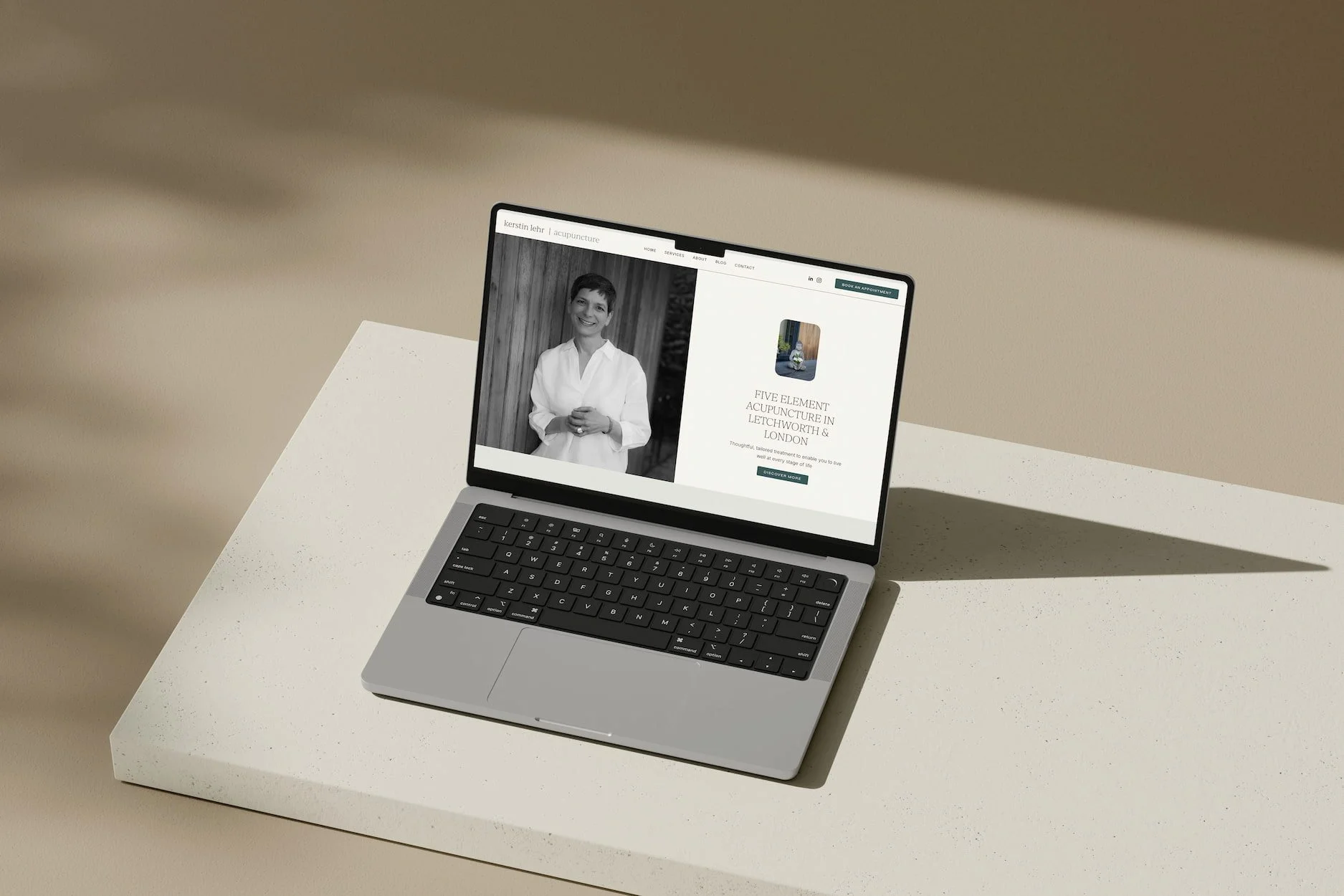
One example is acupuncturist, Kerstin Lehr. For Kerstin, a five-page website made sense. There was enough to communicate about her, her approach, treatments and the practical side of working with her that putting everything onto one long page would have felt cramped.
Five pages gave us room to tell the story properly, while still keeping the website really clear and easy to navigate.
But another business might genuinely only need one page. I’ll come back to that, because bigger is definitely not always better.
What makes one five-page website £900 and another £2,500?
And this is where I think people get caught out.
If a designer quotes you for a five-page website, find out exactly what that means. Are you expected to arrive with your complete brand identity, colour palette, typography, photography and finished copy ready to upload, or is your designer helping you establish the visual direction?
Are they simply placing your copy onto pages, or do they understand how copy needs to work and make suggestions around hierarchy, clarity and conversion? What about imagery — do you need to source every photograph yourself, or is your designer curating stock imagery that actually works together?
Then there are all the other things that can sit behind those five pages. Is SEO included — and what do they actually mean by SEO? Are there strategy calls? How many rounds of revisions are included? Will they connect your domain and submit your site to Google? What happens at launch, what support do you get afterwards, and how long will the whole process take?
You could wait several months for a £1,500 website or have a dedicated week in someone's diary at £2,500. They’re simply not the same product.
Don't compare website designers by page count alone. Compare what happens before, during and after those pages are designed.
SEO is another reason Squarespace website prices vary
This is a big one for me.
There is a difference between filling in your SEO page titles and descriptions and actually developing an SEO strategy. They are not the same thing.
If organic search matters to your business, I believe SEO needs to be considered before the website is built — not sprinkled over it afterwards. That can mean keyword research, competitor research, understanding search intent, deciding which pages need to target which subjects, structuring headings properly, optimising on-page content and making sure the foundations are there for Google to understand your business.
That work takes time and expertise.
With my five-page Website in a Week, SEO strategy and optimisation for the homepage are built into the project. I'm an accredited SEO specialist as well as a Squarespace designer, so I'm looking at both sides of the website rather than simply making something beautiful and calling it finished.
Not every business needs an extensive SEO strategy. If all of your clients come through referrals and nobody is realistically searching for what you do, it may not be a priority. But if search is an important route to new business, find out exactly what your designer means when they tell you that “SEO is included”.
Why do some Squarespace websites cost £5,000–£10,000?
There are completely legitimate reasons for a Squarespace project to cost considerably more.
The website may simply be much bigger, with substantial amounts of content to structure and design, complex functionality, custom coding or features that need to be designed specifically for that business. The project might include copywriting or extensive SEO work across multiple pages.
There may also be a full brand identity project involving strategy, logos, submarks, icons, typography, colour systems and other brand assets. Or you may be hiring a designer or studio with a very established reputation and high demand.
Agency pricing can also be different from freelancer pricing. An agency may have strategists, designers, developers, copywriters, account managers and other members of staff involved in the project, with the overheads that come with running a larger business.
That doesn't make an agency better than a freelancer, or vice versa. They're simply different ways of delivering a project.
You don't automatically need a £7,000–£10,000 website just because you want an excellent one. You need that level of budget when the scope of the project warrants it.
Do you need professional branding as well?
Not necessarily — and this is another area where you can end up spending a lot more if the project grows in scope.
A lot of my clients come to me without a fully developed brand identity. They might know roughly which colours they like and have a feeling for how they want their business to come across, but they haven't spent thousands of pounds on branding. And for many small service businesses, that's absolutely fine.
We can create a sophisticated visual direction through a considered colour palette, typography, imagery and styling without turning it into a full branding project. Sometimes a beautifully chosen typeface is enough for a simple logo.
Other businesses genuinely do need a much deeper brand exercise — and if you want bespoke logos, submarks, illustrations, icons, messaging and a complete brand system, you should expect that to add substantially to the project cost.
Again, it's about what your business actually needs.
What other costs should you budget for?
Your web designer's fee isn't the only cost involved in launching a website. Depending on your business, you may also need to consider:
Your Squarespace subscription
With my website packages, I include the first year of a Squarespace Core plan. From year two onwards, you take over the annual subscription yourself.
Your domain name
You'll need to register your domain either through Squarespace or independently. I generally like clients to keep their domain separately with a domain registrar so it isn't tied to their website platform.
Photography
I am a huge fan of a good branding shoot, particularly if you are your business.
If you're a coach, photographer, consultant or another personal service provider, potential clients want to get a sense of the person they're going to work with. You don't necessarily need 100 photographs of yourself, but having some really good, natural brand imagery makes a huge difference.
A professional branding shoot might cost somewhere around £300–£1,000, depending on the photographer, location and scope. That said, not everybody needs a full shoot. You can combine a few strong photographs of yourself with carefully curated stock imagery, and AI imagery also has its place if it's used thoughtfully.
Copywriting
Professional copywriting can add hundreds or thousands of pounds depending on the size of the project.
AI has changed this area enormously, but I wouldn't recommend asking AI to “write my homepage”, copying the result and considering the job done. Your copy still needs your tone of voice, your experience and your point of view.
Stock photography
There are excellent free libraries such as Unsplash, and a good designer can curate imagery from different sources so it feels cohesive.
This is more important than people think. You can find five individually lovely photographs and still end up with a website that feels completely disjointed because the lighting, colour, styling and mood don't work together.
I’ve written a blog post on the best sites for free stock photos and how to create a cohesive look if you need somewhere to start.
Premium libraries such as Haute Stock can give you something a little more distinctive, or you can buy beautifully coordinated image collections on Creative Market.
Then of course there are plenty of AI tools for creating on-brand imagery, such as Midjourney. These can be incredibly useful because it’s much easier to create a collection of cohesive images when you have control over how they look. I’m not a fan of wholly AI photoshoots of people, but for complementary images, it can be a really useful tool.
Custom fonts
This is one of my favourite relatively small upgrades.
Squarespace has plenty of good fonts built in, but sometimes a custom font is the thing that takes a website from perfectly nice to beautifully polished. It's a small detail, but these are often the things that give a website that extra bit of finesse. Typically these cost around £25 for a web licence and you may also need the desktop licence if you want to use the font in Canva. Note: A pro Canva account is required to upload a custom font.
Email marketing and plugins
If you want newsletters, automated email sequences or more advanced functionality, there may be additional subscriptions. Occasionally I also use a paid Squarespace plugin where it adds something worthwhile to the design or functionality.
You won't necessarily need all — or even most — of these. That's another reason it's useful to discuss the whole project with your designer rather than simply asking, “How much for five pages?”
Should you just build your Squarespace website yourself?
Sometimes, yes.
If you're testing a business idea, running something as a hobby or simply need a temporary web presence while you work out what you're doing, I wouldn't tell you to spend thousands of pounds on a website. Squarespace is genuinely straightforward to use. That's one of the reasons I love it.
And if you do want to build your website yourself but don’t particularly want to start from a completely blank page, a good Squarespace template can be a really nice middle ground. You’re still building and managing the website yourself, but you’re starting with the layout, typography and overall visual direction already thought through, rather than having to make every design decision from scratch.
There are some really beautiful premium template options out there too. Studio Founded has a particularly lovely collection of design-led Squarespace templates if you want something that already feels considered and editorial, while still giving you plenty of scope to make it your own.
If you’re a photographer, I have my own Vivienne Squarespace template for photographers, which gives you that professionally designed starting point while still leaving you plenty of scope to add your own colours, imagery and personality.
But there is still a difference between being able to operate Squarespace and being able to design a professional website. And honestly, I see the same things happen again and again with DIY sites.
Someone starts with a perfectly good template. Then they change the images, add a different section and try another font. They make this heading bigger, add an arched photograph here and a square one there and, most commonly of all, shoehorn huge blocks of text into sections.
None of those individual decisions seems particularly dramatic, but by the time it's all been changed, the visual consistency of the original design has disappeared and you're left with something that feels a little bit chaotic.
Professional design is often about all those tiny decisions you barely notice when they're right: spacing, proportion, typography, image selection, hierarchy, consistency and knowing what to leave out.
Technically building the page is only part of the job.
I've written much more about the common Squarespace DIY mistakes I see, and if you're sitting on the fence about whether to keep going yourself, my guide to whether you should hire a Squarespace designer or DIY goes into that decision in more detail.
When is it worth paying for a professional website?
If you're genuinely building a professional business, I think your website needs to reflect that.
I've worked with photographers who have invested thousands in cameras, lenses, training and education. Counsellors and therapists may have spent years studying and qualifying. Interior designers, coaches and other professionals have invested heavily in developing the expertise they're now asking clients to pay for.
And then your website is the interface between all of that expertise and the person deciding whether to contact you.
That bit matters.
We are exposed to sophisticated brands online all day, every day. People may not consciously be able to explain why one website feels professional and another doesn't, but they notice. And if they're comparing you with three other businesses, presentation matters.
If you've got a DIY website that feels a bit muddled and the person down the road has a gorgeous, clear, considered website, with beautiful imagery and copy that makes it immediately obvious why they're good at what they do, that is going to influence how the two businesses feel.
Your website starts creating trust before you've ever had a conversation.
What if £2,000+ simply isn't in the budget?
Then I would rather see you go smaller, but go higher end.
You don't necessarily need five pages. A lovely example is PopCourt, a podcast management business I designed a one-page website for.
Founder Courtney had three core services, but we didn't need to spread everything across multiple pages just because we could. One strong, beautifully structured page gave us enough room to explain what she did, demonstrate her expertise and give prospective clients a clear route to work with her.
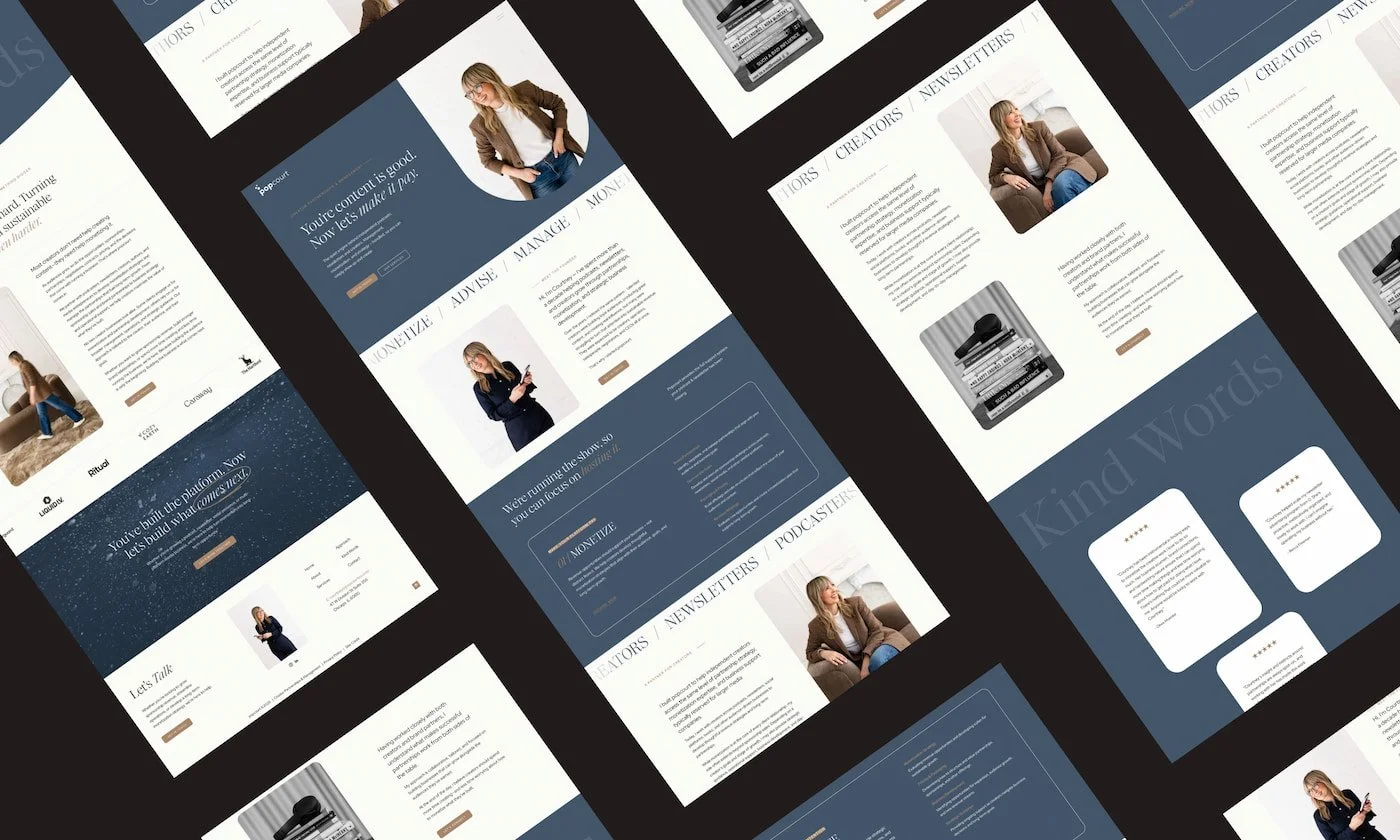
It looked professional, felt complete and did its job. That's exactly what a good One Page Website should do.
If you're starting out, have one clear service, already have an audience elsewhere or simply need a professional place to send people, a really good one-page website can be enough. And you can add pages as the business grows.
I'd rather build you one strong, considered page than encourage you to stretch yourself financially for a website you don't yet need — or create five DIY pages purely for the sake of having a bigger website.
More isn't automatically better.
If you’re considering the more streamlined option, I’ve explained when a one-page website is enough in more detail.
How to compare Squarespace website quotes
If you have three quotes sitting in front of you, don't automatically choose the cheapest — or assume the most expensive must be the best. Do your due diligence.
Look properly at the designer's portfolio, not just one beautiful homepage. Does their body of work look like the level and aesthetic you're hoping for? Have they worked with businesses like yours? Do they have independently verifiable reviews?
If Squarespace is their specialist platform, look at their Squarespace credentials too. Are they a Silver, Gold or Platinum Partner with Squarespace Circle? Are they a Marketplace Expert — part of Squarespace's own directory of designers? How much experience do they actually have with the platform?
And speak to them. I think having a face-to-face video call before choosing your designer is really valuable.
You're going to be handing this person your business, your ideas and quite a lot of money. You need to feel comfortable with them. You need to like their energy, trust their judgement and feel that they actually understand what you're trying to achieve.
Ask what happens during the project, what isn't included, what the process is for revisions and support, and who will actually be designing your website.
And ask yourself one very simple question when you're looking at their previous work:
If this were my website, would I be delighted with it?
One small word of caution about viewing live client sites: remember that clients take control of their websites after handover. I've handed over websites I've been incredibly proud of and returned months later to find images replaced, fonts changed and spacing altered.
That's one reason I show my own record of the finished project in my portfolio rather than relying entirely on how a client's live website looks several years later.
So, is a professional Squarespace website worth the money?
For the right business, absolutely.
A good website should last you years. It will evolve — websites always do — but if it's set up properly, the underlying foundations should remain.
So don't only look at the cost of having your website professionally designed. Consider the cost of not doing it.
What does it cost your business if potential clients visit your website and don't trust what they see? What does it cost if you're invisible in search when your competitors aren't? What does it cost if someone who would have been a brilliant client chooses the person down the road because their business simply looked more established?
For a coach selling a £1,000 programme, a wedding photographer charging £2,500–£3,000 or an interior designer working on substantial projects, it may only take one or two additional clients before the investment of a new website pays for itself.
And that's the way I tend to think about website cost.
If you've spent years developing your expertise, invested in training, equipment or qualifications and you're serious about building a business from it, your website shouldn't be the final thing that lets you down.
Invest at a level that's right for where your business is now. And if that means starting smaller, start smaller.
Just make it good!
FAQS about Squarespace website costs
-
A professionally designed five page Squarespace website in the UK will typically cost somewhere between £1,500 and £5,000+, depending on the designer, the level of customisation and what’s included. Some designers will also include things like SEO, copy support, mobile optimisation or the Squarespace subscription, so it’s worth comparing the full scope rather than the headline price alone.
-
Squarespace designers charge in different ways. You might pay around £1,000–£2,000 for a smaller or more straightforward website, while an experienced designer offering a more strategic, bespoke service may charge £3,000–£5,000 or more. The price usually reflects not just the number of pages, but the strategy, design expertise, SEO and support included.
-
Not always. Usually, your Squarespace subscription is an ongoing cost paid separately to Squarespace, so it’s worth checking exactly what your designer includes.
For example, my Made by Friday™ website and One-Page Website packages both include your first year of Squarespace, so there isn’t an additional platform fee to pay when we launch your new site.
-
Yes, in terms of the upfront cost. If you build it yourself, you may only need to pay for your Squarespace subscription and perhaps a template or a few additional tools.
The bigger consideration is your time — and whether you feel confident creating a website that looks professional, clearly communicates what you do and has the right foundations in place to be found through search.
-
It depends entirely on the designer and their process. A traditional website project may take several weeks or even a few months, particularly if copywriting, branding or more complex functionality is involved.
My Made by Friday™ service takes a different approach: your five-page Squarespace website is designed and launched in one focused week, providing your content is ready before we begin. -
Sometimes. Some designers offer SEO as a separate service, while others include basic SEO within their website packages. It’s worth finding out exactly what “SEO included” means, as this can range from simply filling in page titles and descriptions to proper keyword research and on-page optimisation.
SEO strategy and on-page optimisation are built into my Squarespace website services, rather than being treated as an afterthought once the site has been designed.
Ready to invest in a Squarespace website?
If you’re ready to move on from DIY and want a website that looks beautiful, feels like your business and has solid SEO foundations built in from the start, I can help.
I offer focused Squarespace website design for small service-based businesses, from a beautifully considered one-page website to my five-page Made by Friday™ service, designed and launched in one focused week.